September 25, 2026
What Box and Papers Really Tell You About a Pre-Owned Watch
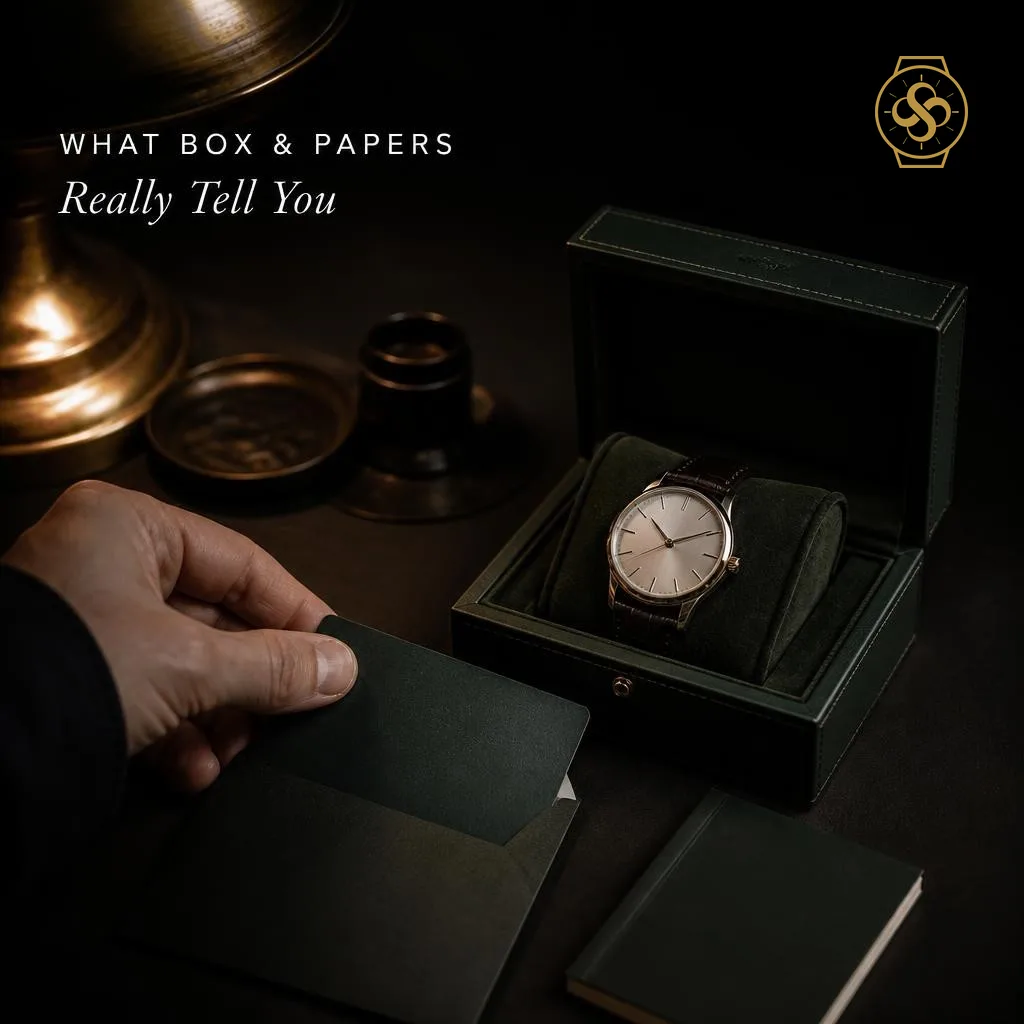
A watch listing says "box and papers included." That sounds reassuring, but it leaves an important part of the purchase unresolved: what those materials actually establish about the watch in front of you.
Box and papers can provide useful context. Their presence alone cannot establish authenticity, originality, condition, or ownership history. Their relevance depends on the reference, the materials included, and how well those materials connect to the watch.
For a buyer, the practical task is to understand what accompanies the piece, what that information supports, and what still needs verification.
Start with what "box and papers" actually means
Treat the phrase as the start of a discussion. Ask the seller to identify the individual items included.
"Papers" might refer to a warranty document, an instruction booklet, service paperwork, a purchase receipt, or some combination of these. Each has a different purpose, and the information it contains determines what it can help establish.
A booklet may explain how a watch functions without identifying an individual watch. A document carrying watch-specific details may offer a more useful point of comparison, provided someone checks the document and its connection to the piece.
The box needs its own clarification. Ask whether the seller describes it as the box supplied with that particular watch, packaging appropriate to the reference, or simply a box included in the sale.
Those descriptions make different claims. A complete list of included items gives you something concrete to assess. A broad label leaves room for assumptions.
1. Understand why the reference changes the discussion
The reference identifies the particular model or version under consideration. It provides a starting point for understanding the watch's expected details and which accompanying materials may be relevant.
Avoid applying one packaging checklist to every pre-owned watch. What belongs with a particular piece can depend on its reference and the circumstances of its original sale.
The same caution applies to judging something missing. Before treating an absent item as a concern, establish whether there is a sound reason to expect that item with this watch.
Context includes your purpose as a buyer. A collector seeking a carefully documented example may place considerable importance on the accompanying materials. Someone choosing a watch primarily to wear may accept fewer accessories, while still requiring careful verification of the watch itself.
Neither preference answers the authentication question. They help define whether a particular offering fits the purchase you want to make.
Separate your preference for completeness from your standard for verification. You can be flexible about packaging without becoming flexible about accuracy.
2. Give each document only the weight it earns
Accompanying materials can support specific parts of a watch's history or description. The useful question is how far that support extends.
Consider the limits of each item: a watch-specific document may help connect identifying details to a recorded sale, warranty, or other event, depending on its contents and credibility. Service paperwork may provide information about work recorded at a particular time, if it clearly relates to the watch. A purchase receipt may support details of a transaction, subject to checking its source and connection to the piece. Instructions and packaging may contribute to the completeness of the offering without establishing the identity of the individual watch.
Read the actual contents. A document's title does not tell you everything it proves.
For example, a record of specified service work supports a narrower statement than "everything in the watch is original." Likewise, a document relating to one transaction does not, by itself, establish an uninterrupted ownership history.
Warranty paperwork also deserves careful wording. Possessing a warranty document alone does not establish that coverage remains available. Any claim about current coverage needs its own confirmation under the applicable terms.
3. Keep authenticity, originality, and condition separate
These terms address different concerns. Combining them into one reassuring description makes it harder to know what someone has actually checked.
Authenticity concerns whether the watch is genuine. Box and papers can form part of the supporting information, but they cannot settle that question independently of the watch.
Originality concerns the watch's components and configuration. A genuine watch may still require clarification about replacements, modifications, or other changes. Accompanying documents may help explain some of those details, but their presence does not establish that every component remains as originally supplied.
Condition concerns the watch as it exists now. Packaging cannot tell you whether the movement needs attention, whether the case has undergone refinishing, or whether the seller's description accurately reflects current wear.
A historical document also has a time limit as evidence: it records information associated with a particular point in time. It cannot automatically establish the watch's present state.
A careful buying discussion addresses these concerns separately, with clear explanations of what supports each conclusion and what remains uncertain.
4. Check the connection between the materials and the watch
There are two separate matters to assess: the materials themselves and their relationship to the piece.
A document may appear relevant while leaving that relationship unclear. Packaging may suit a reference without establishing that it accompanied this individual watch from the beginning.
Where documents contain identifying details, those details should agree with the watch and the seller's description. Any inconsistency deserves an explanation before you proceed.
Agreement is useful evidence, but matching information alone is not conclusive proof. It does not remove the need to assess the watch or the credibility of the accompanying materials.
The appropriate review depends on the reference, the questions raised, and the evidence available. There is no responsible reason to promise that one universal checklist will resolve every watch purchase.
Ask the seller to explain the basis for meaningful claims. If the description says "original papers" or "original box," clarify exactly what "original" means in that context and how the seller supports it.
An unresolved point should remain visible in your decision. You do not have to turn an incomplete answer into a reassuring one.
5. Assess missing materials without jumping to a verdict
An absent box or document leaves you with less accompanying material to assess. It does not, on its own, establish that the watch is counterfeit or unsuitable.
Equally, a complete-looking package does not settle whether the watch is genuine or accurately described.
The practical response is to identify what the absence prevents you from confirming. Missing instructions may have a different significance from missing documentation that you wanted to support a specific part of the watch's history.
Then consider your own requirements. If documented history or a particular level of completeness matters to you, a watch without it may simply be the wrong fit.
Avoid supplying a convenient explanation for missing items. If the seller does not know what happened to the papers, "unknown" is the accurate answer.
You can make an informed decision with some uncertainty. The important part is understanding where that uncertainty sits and whether you are comfortable accepting it.
6. Compare the whole offering before judging the price
Box and papers may influence a buyer's preference and the way a particular watch competes with comparable offerings. Their financial significance depends on the reference, the materials, and the context of the transaction.
There is no useful universal premium or discount to apply.
When comparing listings, look beyond the accessory count. Consider the watch's described condition, configuration, documented history, accompanying items, and the terms of the sale.
A higher asking price does not establish better verification. A lower asking price does not explain which uncertainties you may be taking on.
If a seller attributes part of the price to completeness, ask what specifically supports that description. Decide whether those items matter enough to your purchase to justify the difference.
7. Get clear answers before committing
Use these questions to make the discussion specific: What exactly comes with the watch? Request an itemized list and clear images of the included materials. Which items identify this individual piece? Separate watch-specific records from general packaging and instructions. What does the seller claim about each item? Clarify terms such as "original," "matching," and "complete." How has the watch itself been assessed? Ask what supports the description of authenticity, configuration, and current condition. What remains unknown? Identify missing history, unclear documentation, and any unresolved inconsistencies. What purchase protections apply? Understand the written sale terms and how a material discrepancy would be handled.
Keep the description, included items, and important representations clear in the written purchase record.
At Sanctum Timepieces, we believe a buyer should understand the basis of the purchase before committing. That includes the limits of the information available.
Give box and papers the weight their contents and connection to the watch justify. Before you buy, make sure the watch's own details receive the scrutiny they require.
Have a piece in mind, or looking to sell one?