September 24, 2026
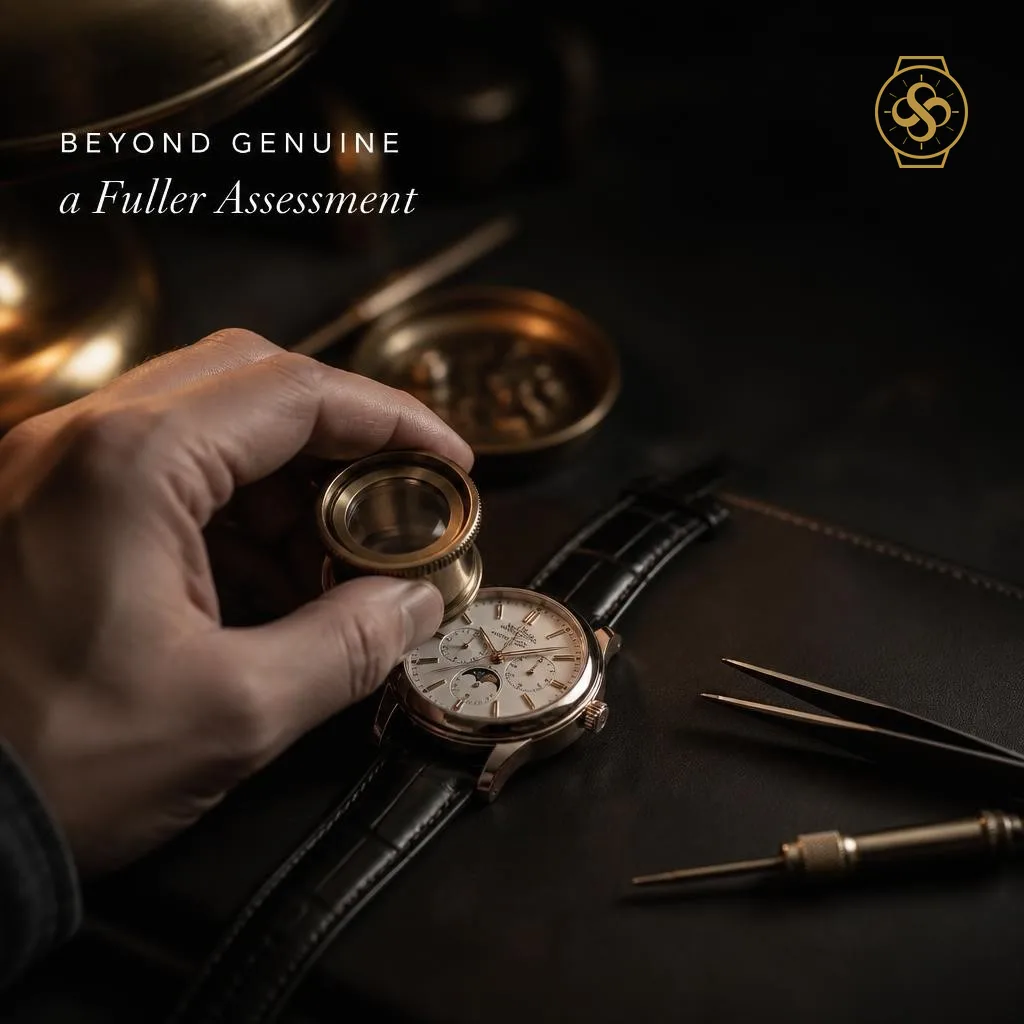
Why a Genuine Watch Still Needs a Fuller Assessment
A genuine watch can still leave important questions unanswered. Establishing that it is genuine does not, by itself, explain its condition, how much of its original configuration remains, what accompanies it, how well its history is supported, or how it functions.
For a buyer, those distinctions matter. "Genuine" answers one part of the purchase decision. Treating it as a complete assessment places more weight on that answer than it can reasonably carry.
A broader approach to authentication considers condition, originality, completeness, provenance, and function while keeping each finding separate. Together, these dimensions help describe the watch under consideration. None should stand in for the others, and no single factor proves authenticity.
What an authenticity judgment can and cannot tell you
The genuine-or-not question has a clear purpose. A buyer needs to understand whether a watch is what it purports to be.
The difficulty begins when that answer becomes shorthand for everything else. Authenticity does not automatically establish originality, completeness, or satisfactory function. Nor does it turn an uncertain history into a documented one.
A fuller assessment gives each consideration its own place. It explains what the available information supports, where uncertainty remains, and which conclusions require separate support.
This distinction also keeps expectations realistic. An assessment concerns a particular watch and the information available about it. It cannot guarantee future performance or value.
The five considerations below provide a general framework for understanding that fuller picture. They do not establish a conclusion about any individual watch.
1. Condition describes the watch as it is now
Condition concerns the watch's present physical state. It gives meaning to a description that would otherwise stop at identity.
A watch can be genuine and still have a condition that deserves careful consideration. The authenticity judgment alone leaves that subject unresolved.
Useful condition information is specific enough for a buyer to understand what a broad description means. A general label can summarize an assessment, but it cannot carry all the detail behind it.
There is also a difference between a condition finding and a buyer's preference. The finding describes the watch; the preference concerns whether that state is acceptable to the person considering it.
Keeping those two things separate allows buyers to make an informed decision without turning personal standards into universal rules.
Condition is a present-state assessment. It should not imply that the watch remains entirely original, has a fully supported history, or will perform in a particular way in the future. Those are separate considerations, even when they influence the same purchase decision.
2. Originality concerns what remains as originally made
Originality addresses the relationship between the watch's current configuration and its original state. It is distinct from the question of whether the watch is genuine.
That distinction deserves clear language. A conclusion about genuineness does not explain whether everything remains as originally made, whether changes have occurred, or how much is known about those changes.
"Original" also needs a clear scope. A statement about one part of a watch should not silently become a claim about the entire watch. Where the available information supports only a limited conclusion, the wording should remain limited.
An originality assessment should identify what is known and leave unresolved points visible. Uncertainty is part of the description when the evidence does not support a firmer answer.
A buyer can then consider originality according to their own priorities. Its relevance to that decision does not make it a substitute for condition or function.
Genuineness and originality need separate conclusions. Combining them into a single reassuring word removes information the buyer may need.
3. Completeness concerns what is included
Completeness addresses the scope of what comes with the watch, including any associated materials represented as part of the purchase.
The useful question is whether the contents are clearly defined. A broad claim of completeness needs an understandable reference point: complete in relation to what the seller describes, or to some other stated expectation.
Without that reference point, a buyer may read more into the description than the available information supports.
A clear assessment distinguishes the watch itself from the materials accompanying it. It also separates what is present from what those materials establish. Their inclusion and their evidential meaning are different matters.
This prevents completeness from becoming a shortcut to other conclusions. The presence of associated materials does not, on its own, prove authenticity, establish an uninterrupted history, or resolve questions about condition.
Completeness describes the contents of the purchase. It helps the buyer understand exactly what is under consideration, while leaving the other dimensions open to their own assessment.
4. Provenance concerns the supported history
Provenance addresses what is known about a watch's history and the basis for that knowledge.
The distinction between a stated history and a supported history is important. A description may contain information about the past, but the confidence placed in it should reflect the support available.
A responsible account of provenance makes those limits understandable. It distinguishes documented information from statements that remain unverified and acknowledges periods or details that are unknown.
An incomplete history should remain described as incomplete. Missing information does not justify filling in the story, and it does not, by itself, settle whether the watch is genuine.
Provenance also has boundaries. Information about the past cannot automatically establish present condition or function. Equally, an assessment of the watch today cannot supply a history that the available information does not support.
Provenance adds context with a stated level of confidence. Its usefulness depends on keeping the account proportionate to the evidence, rather than making the history sound more certain or more complete than it is.
5. Function concerns how the watch operates
Function addresses the watch's operation. It belongs in the assessment because a conclusion about identity leaves performance unresolved.
The language used here should match the scope of what has actually been established. A limited finding about operation should remain a limited finding, rather than expand into an assurance about every aspect of performance.
A buyer also needs to distinguish current findings from future expectations. An assessment can describe what was established at the time; it cannot guarantee how the watch will perform later.
Function should remain separate from appearance. A condition description does not answer all operational questions, just as an operational finding does not describe every aspect of physical condition.
The same boundary applies to originality and provenance. Neither conclusion removes the need to consider function on its own terms.
Function is a distinct part of the purchase picture. Clear wording allows the buyer to understand the finding without mistaking it for a promise about future reliability.
How the five considerations fit together
These dimensions relate to the same watch, but they answer different questions. Combining them is useful only when their individual meanings remain visible.
A clear assessment allows a buyer to distinguish: condition, the watch's present physical state; originality, its relationship to its original configuration; completeness, the defined contents accompanying the purchase; provenance, the history supported by available information; and function, what has been established about its operation.
There is no need to compress those findings into a single approval label. Doing so can hide uncertainty in one area behind confidence in another.
The more useful reading is specific: a conclusion may be well supported in one dimension while another remains unresolved. That is a description of the available knowledge, not a contradiction.
General guidance provides the framework. Only information relating to the individual watch can support conclusions about that watch.
A fuller assessment leaves its limits visible
Transparency means giving a buyer enough clarity to understand both the findings and their boundaries.
A genuine-or-not answer remains important. Its role becomes more useful when condition, originality, completeness, provenance, and function accompany it as separate considerations.
The result is a fuller basis for judgment: a description of the watch's current state, the scope of the purchase, the support for its history, and the limits of what is known. Any remaining uncertainty stays visible, without becoming either an unsupported reassurance or an unsupported verdict.
Have a piece in mind, or looking to sell one?